



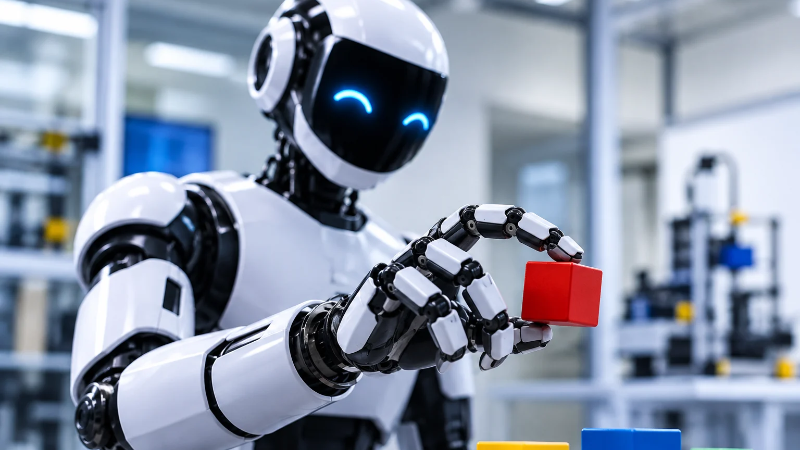
Lupa Robotics, an artificial intelligence startup founded in 2026 by South African engineering student Nureldin Mohamed, has raised $1.67 million in early funding. Long Journey Ventures led the round, which comprised unnamed investors. The business is creating AI models to teach robots human dexterity by gathering and evaluating data on how people use their hands.
The funds will be used to hire new engineers, develop tactile-sensing and data-collection technologies, and create large-scale human-manipulation datasets for model training and validation. Lupa advertises itself as still in the research and development stage. It intends to license its manipulation datasets first, followed by its pre-trained robotics models, with users ranging from robotics companies to AI research laboratories.
Mohamed, who studies Bioengineering and Computer Science at Harvard, founded Lupa to address an issue known as dexterous manipulation: a robot’s ability to grab objects with its fingers while controlling where it makes contact and how much force it applies. The issue arises most frequently when robots encounter unexpected items or environments. A robot may easily handle a recognized thing on a regulated factory floor, but struggle when the object’s shape or weight changes.
Lupa obtains data by wearing sensor-equipped gloves that detect hand movements and force applied to an object. At the same time, head-mounted cameras record the same activity from the wearer’s perspective. The company integrates the two data streams to generate databases that show how people interact with objects, which are then used to train robot models. Mohamed explained that the idea is for what a model learns about handling items to be transferable between machines, but each robot will still need its own controller to transform the model’s predictions into hardware actions.
The round comes as African robotics lags significantly behind the rest of the globe. The African Robotics Network’s (AfROB) first “State of Robotics in Africa 2026” assessment estimates the continent’s average industrial robot density at 10 robots per 10,000 manufacturing workers. According to the International Federation of Robotics (IFR), the global average for 2025 will be 152 robots per 10,000 workers.
Lupa’s round is small compared to others in physical AI. Genesis AI, which similarly collects force data via sensor gloves and headset cameras, announced a $500 million Series A round in November, despite the fact that the two businesses are in very different phases and scales. Enact Intelligence, based in Zurich, reportedly raised $30 million in a pre-seed funding round in October.
South Africa’s artificial intelligence and robotics ecosystem is young but growing. According to RevenueBase, the country has 32 AI-powered robotics firms in September 2026. Robotforge, based in Lagos, deals with physical AI data. The Presidential African Youth AI and Robotics Competition, a continental initiative that connects young inventors with investors and officials, had its 2025 finale in South Africa.
Lupa’s commercial potential is unknown because it is currently in the research and development stage. The company has not offered a commercial pilot valuation or a schedule. It mentions industrial, textile, and warehousing automation as early use cases.
Lupa’s next steps are to increase data collecting, test its models on other robot platforms, and prepare for commercial pilots. For those developing on the continent, it is a bet on fundamental AI research, which receives far less attention than consumer software or fintech. If it works, it will demonstrate how useful deep tech ventures in Africa can be, particularly in physical AI for industry. The major question is whether Lupa can transform its human-hand data into a repeatable solution that industrial and shipping companies would really incorporate into their operations.